|
hexed 0.4.0
|

|
|
hexed 0.4.0
|
|
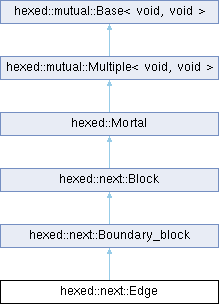
A 1-dimensional Block connecting 2 Vertexs.
More...
#include <Block.hpp>
Public Member Functions | |
| Edge (Vertex &vertex0, Vertex &vertex1, const Basis &) | |
Constructs an Edge with endpoints vertex0 and vertex1. | |
| Vertex & | vertex (int i_vert) |
| access the vertices (index 0 or 1) | |
| const Vertex & | vertex (int i_vert) const |
| This is an overloaded member function, provided for convenience. It differs from the above function only in what argument(s) it accepts. | |
| std::vector< Element_shape * > | dependent_elements () |
Obtains all the Element_shapes whose point() depends on this | |
| std::vector< int > | element_coords (std::vector< int >) const override |
Transforms node coordinates from the space of the Block to its Element_shape | |
| std::vector< Vertex * > | vertices () override |
| void | reset () override |
sets interior() to linear interpolation between vertices | |
| void | set_points (Array< double > points) override |
Sets the interior, edge, and vertex points to points. | |
| void | glue (Edge &that, int half=no, bool reverse=false) |
| Glues the edge to another edge (or half of it). | |
| void | unglue () |
If this edge is currently glue()d, unglue it. | |
| bool | glued () const |
true iff this is currently glue()d to another edge | |
| std::vector< Element_shape * > | contacted_elements () |
| Edge * | glued_to () |
| const Edge * | glued_to () const |
| int | glued_half () const |
 Public Member Functions inherited from hexed::next::Boundary_block Public Member Functions inherited from hexed::next::Boundary_block | |
| Boundary_block (int n_dim, const Basis &basis) | |
| const Basis & | basis () const |
| bool | alive () const |
true iff this currently has an Element_shape referencing it. | |
| void | pair (mutual::Base< Element_shape, Boundary_block > &elem) |
sets elem to point to this | |
| Element_shape * | element () |
Get the element this is pair()d with (nullptr if not paired). | |
| const Element_shape * | element () const |
| Array< double > | interior () |
| A modifiable view of the interior points. | |
| Public Member Functions inherited from hexed::next::Block | |
| Block (int n_dim, int row_size) | |
| int | n_dim () const |
| number of topological dimensions. | |
| int | row_size () const |
| number nodes along each dimension | |
| Mat< 3 > | point (const std::vector< int > &node_coords, Int recursion_depth=0) const |
Obtains the node with array indices specified by node_coords. | |
| Mat< 3 > | point (int i_point, Int recursion_depth=0) const |
Obtains the node with flat index i_point | |
| virtual Array< double > | points () const |
| Obtains all the nodes as a multidimensional array. | |
| void | visualize (std::string format, std::string file_name, double time=0.) const |
Visualizes the nodes of a single Block. | |
| Public Member Functions inherited from hexed::mutual::Multiple< void, void > | |
| Multiple (const Multiple &)=delete | |
| Multiple (Multiple &&that) | |
steals all of that's partners, leaving that unconnected | |
| Multiple & | operator= (const Multiple &)=delete |
| Multiple & | operator= (Multiple &&that) |
steals all of that's partners, leaving that unconnected | |
| next::Sequence< Base< void, void > & > | partners () |
| provides access to the list of partners | |
| next::Sequence< const Base< void, void > & > | partners () const |
| provides access to the list of partners | |
| Public Member Functions inherited from hexed::mutual::Base< void, void > | |
| virtual void * | _mine () |
| virtual const void * | _mine () const |
| This is an overloaded member function, provided for convenience. It differs from the above function only in what argument(s) it accepts. | |
Public Attributes | |
| Int | snapped_edge |
| Public Attributes inherited from hexed::next::Boundary_block | |
| bool | snapping_problem |
Static Public Attributes | |
| static const int | no = -1 |
Used in glue() to indicate that you are not gluing to either half of the target edge. | |
| Static Public Attributes inherited from hexed::next::Block | |
| static constexpr Int | max_recursion_depth = 100 |
Additional Inherited Members | |
| Static Public Member Functions inherited from hexed::next::Block | |
| static void | visualize (std::string format, std::string file_name, next::Sequence< const Block & >, double time=0.) |
Visualizes the nodes of a set of Blocks. | |
| Protected Member Functions inherited from hexed::mutual::Base< void, void > | |
| void | _connect (Base< void, void > &that) |
may be overridden by derived classes to provide partners to data of some arbitrary type T | |
| void | _disconnect (Base< void, void > &that) |
mutually disconnects this and that by calling both of their _unset() member functions | |
| Static Protected Member Functions inherited from hexed::mutual::Base< void, void > | |
| static void * | _yours (Base< void, void > &that) |
Accesses the _mine() of that | |
| static const void * | _yours (const Base< void, void > &that) |
| This is an overloaded member function, provided for convenience. It differs from the above function only in what argument(s) it accepts. | |
| Protected Attributes inherited from hexed::next::Boundary_block | |
| Array< double > | _interior |
| storage for the interior points | |
| Protected Attributes inherited from hexed::mutual::Base< void, void > | |
| Lock | _lock |
A 1-dimensional Block connecting 2 Vertexs.
This class is only used to represent boundary edges, since interior edges are not free (their position is always determined by linear interpolation between the vertices). Both 2D and 3D meshes have Edges, but their role is different. In 3D, boundary Edges form the interfaces between boundary Surface_faces. In 2D, boundary Edges are the boundary faces (or boundary sides might be a better term).
Constructs an Edge with endpoints vertex0 and vertex1.
point({0}) will return vertex0.point({}) and point({row_size() - 1}) will return vertex1.point({}). Vertex::eat can redirect these to point to different vertices.
|
virtual |
Obtains all the Element_shapes whose point() depends on this
Implements hexed::next::Boundary_block.
|
overridevirtual |
Transforms node coordinates from the space of the Block to its Element_shape
That is, element()->point(elemement_coords(coords)) should give the same result as point(coords).
Implements hexed::next::Boundary_block.
Glues the edge to another edge (or half of it).
Once this is called, the Block::interior() becomes irrelevant, and the Block::points are determine from that as follows:
half == no, this->point returns the same as that.pointhalf == 0, the points are interpolated to the first half ( \( \xi \in [0, 0.5] \)) of that.half == 1, the points are interpolated to the second half ( \( \xi \in [0.5, 1] \)) of that.half are illegal.If that is destroyed, this edge is no longer glued and Block::point once again respects interior(). Unlike in the case of Vertex::glue, interior() is not updated to match the latest value of point().
|
overridevirtual |
sets interior() to linear interpolation between vertices
Implements hexed::next::Boundary_block.
|
overridevirtual |
Sets the interior, edge, and vertex points to points.
The interior(), as well as any connected Edges and Vertexs will be modified. After calling set_points(p), points() and p should be equal. The points provided as the argument must have the same shape as points().
Implements hexed::next::Boundary_block.
|
overridevirtual |
Implements hexed::next::Boundary_block.
 1.11.0