|
hexed 0.4.0
|

|
|
hexed 0.4.0
|
|
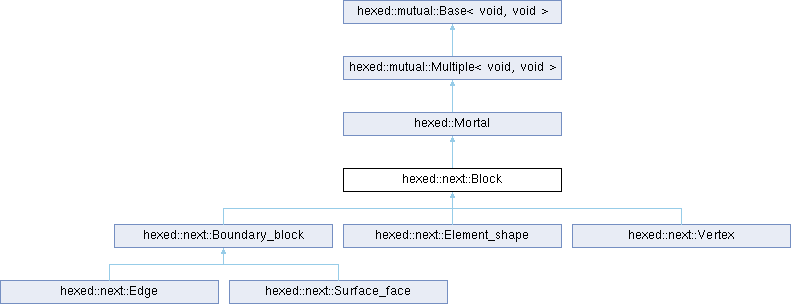
Abstract nodal representation of a parametric block. More...
#include <Block.hpp>
Public Member Functions | |
| Block (int n_dim, int row_size) | |
| int | n_dim () const |
| number of topological dimensions. | |
| int | row_size () const |
| number nodes along each dimension | |
| Mat< 3 > | point (const std::vector< int > &node_coords, Int recursion_depth=0) const |
Obtains the node with array indices specified by node_coords. | |
| Mat< 3 > | point (int i_point, Int recursion_depth=0) const |
Obtains the node with flat index i_point | |
| virtual Array< double > | points () const |
| Obtains all the nodes as a multidimensional array. | |
| void | visualize (std::string format, std::string file_name, double time=0.) const |
Visualizes the nodes of a single Block. | |
 Public Member Functions inherited from hexed::mutual::Multiple< void, void > Public Member Functions inherited from hexed::mutual::Multiple< void, void > | |
| Multiple (const Multiple &)=delete | |
| Multiple (Multiple &&that) | |
steals all of that's partners, leaving that unconnected | |
| Multiple & | operator= (const Multiple &)=delete |
| Multiple & | operator= (Multiple &&that) |
steals all of that's partners, leaving that unconnected | |
| next::Sequence< Base< void, void > & > | partners () |
| provides access to the list of partners | |
| next::Sequence< const Base< void, void > & > | partners () const |
| provides access to the list of partners | |
| Public Member Functions inherited from hexed::mutual::Base< void, void > | |
| virtual void * | _mine () |
| virtual const void * | _mine () const |
| This is an overloaded member function, provided for convenience. It differs from the above function only in what argument(s) it accepts. | |
Static Public Member Functions | |
| static void | visualize (std::string format, std::string file_name, next::Sequence< const Block & >, double time=0.) |
Visualizes the nodes of a set of Blocks. | |
Static Public Attributes | |
| static constexpr Int | max_recursion_depth = 100 |
Protected Member Functions | |
| virtual Mat< 3 > | _point (const std::vector< int > &node_coords, Int recursion_depth=0) const =0 |
| Derived classes must override this function to define the nodes. | |
| Protected Member Functions inherited from hexed::mutual::Base< void, void > | |
| void | _connect (Base< void, void > &that) |
may be overridden by derived classes to provide partners to data of some arbitrary type T | |
| void | _disconnect (Base< void, void > &that) |
mutually disconnects this and that by calling both of their _unset() member functions | |
Additional Inherited Members | |
| Static Protected Member Functions inherited from hexed::mutual::Base< void, void > | |
| static void * | _yours (Base< void, void > &that) |
Accesses the _mine() of that | |
| static const void * | _yours (const Base< void, void > &that) |
| This is an overloaded member function, provided for convenience. It differs from the above function only in what argument(s) it accepts. | |
| Protected Attributes inherited from hexed::mutual::Base< void, void > | |
| Lock | _lock |
Abstract nodal representation of a parametric block.
Hexed represents many parametric block shapes (curvilinear transformations of the unit hypercube) in nodal formats (by an n-dimensional array of node coordinates). This class provides an abstract interface for all such block representations. Although this class supports an arbitrary number of topological dimensions (number of parametric coordinates), the number of geometric dimensions (number of physical coordinates) is always 3. To represent a 2D mesh, just set the last physical coordinate to 0.
| Mat< 3 > hexed::next::Block::point | ( | const std::vector< int > & | node_coords, |
| Int | recursion_depth = 0 ) const |
Obtains the node with array indices specified by node_coords.
node_coords must have n_dim() entries and each entry must be in [0, row_size()). If recursion_depth > Block::max_recursion_depth, throws. If any implementations of Block::_point call Block::point, they should increment recursion_depth to help catch infinite recursion bugs, which would otherwise result in a stack overflow.
Obtains the node with flat index i_point
Block::point
|
virtual |
Obtains all the nodes as a multidimensional array.
This is not a reference. Calling this function allocates memory for the points and changing it will not change the underlying representation. layout: [i_dim \(\in\) [0, 3)] ([i_row \(\in\) [0, row_size())] ([j_row \(\in\) [0, row_size())] ([j_row \(\in\) [0, row_size())])))
|
inline |
number nodes along each dimension
|
static |
 1.11.0