|
hexed 0.4.0
|

|
|
hexed 0.4.0
|
|
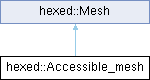
A mesh that supports access to the actual elements with the numerical data they contain. More...
#include <Accessible_mesh.hpp>
Classes | |
| class | Masked_mesh |
| Creates a mask that allows kernel operations to be performed on a subset of the elements. More... | |
Public Member Functions | |
| Accessible_mesh (Storage_params params, double root_size, Turbulence_model turb) | |
| Accessible_mesh (std::string file_name, std::vector< std::shared_ptr< Flow_bc > > extremal_bcs, Turbulence_model, std::shared_ptr< Surface_geom >={}, std::shared_ptr< Flow_bc > surface_bc={}) | |
Reads mesh from a file created by Mesh::write. | |
| double | root_size () override |
| Storage_params | storage_params () |
| View_by_type< Element > & | cartesian () |
| View_by_type< Deformed_element > & | deformed () |
| Element & | element (int ref_level, bool is_deformed, int serial_n) |
| Access an element. If the parameters to not describe an existing element, throw an exception. | |
| Sequence< Element & > & | elements () |
| access all elements, both Cartesian and deformed | |
| Sequence< Kernel_element & > & | kernel_elements () |
| void | connect_cartesian (int ref_level, std::array< Int, 2 > serial_n, Connection_direction dir, std::array< bool, 2 > is_deformed={false, false}) override |
| void | connect_deformed (int ref_level, std::array< Int, 2 > serial_n, Connection_direction direction) override |
| Specify that two elements are connected via a deformed face. Requires both elements to be deformed. | |
| void | connect_hanging (int coarse_ref_level, Int coarse_serial, std::vector< Int > fine_serial, Connection_direction, bool coarse_deformed=false, std::vector< bool > fine_deformed={false, false, false, false}, std::array< bool, 2 > stretch={false, false}) override |
| next::Sequence< Neighbor_connection & > | neighbor_connections (bool is_deformed) |
| next::Sequence< std::vector< Face_refinement > & > | face_refinements () |
| int | add_boundary_condition (std::shared_ptr< Flow_bc >) override |
Acquires owenership of *flow_bc and adds it as a boundary condition. Returns a serial number which uniquely identifies the new boundary condition among this Mesh's boundary conditions. It is recommended to use this with new, like the constructor for std::unique_ptr. | |
| void | connect_boundary (int ref_level, bool is_deformed, Int element_serial_n, int i_dim, int face_sign, int bc_serial_n) override |
| void | disconnect_boundary (int bc_sn) override |
| delete all boundary connections involving a certain boundary condition | |
| void | cleanup () override |
| Does some work that has to happen after you manually add elements and/or connections. | |
| next::Sequence< next::Vertex & > | shape_vertices () |
| next::Sequence< next::Vertex & > | shape_boundary_vertices () |
| void | add_tree (std::vector< std::shared_ptr< Flow_bc > > extremal_bcs, Mat<> origin=Mat<>::Zero(3)) override |
| Initializes meshing with bin/quad/octree topology. | |
| void | set_surface (std::shared_ptr< Surface_geom > geometry, std::shared_ptr< Flow_bc > surface_bc, Eigen::VectorXd flood_fill_start=Eigen::VectorXd::Zero(3)) override |
| Defines the surface geometry to be meshed as a boundary. | |
| void | set_unref_locks (std::function< bool(Element &)> lock_if=criteria::never) override |
| bool | update (std::function< bool(Element &)> refine_criterion=criteria::always, std::function< bool(Element &)> unrefine_criterion=criteria::never) override |
| Updates tree mesh based on user-supplied (un)refinement criteria. | |
| Adaptation_result | plan_adaptation (std::function< bool(Element &, int)> refine_criterion, std::function< bool(Element &, int)> unrefine_criterion, bool set_floor) override |
| void | execute_adaptation () override |
| int | surface_bc_sn () override |
| Surface_geom & | surface_geometry () |
| void | reset_masks () |
| Resets effective number of masks created to 0 and invalidates existing masks. | |
| std::vector< std::unique_ptr< Masked_mesh > > | preti_masks (const Basis &, bool iso) |
| Experimental feature. Ignore for now. | |
| next::Sequence< Flow_bc & > | boundary_conditions () |
| Flow_bc & | boundary_condition (int bc_sn) |
| get a boundary condition owned by this mesh by its serial number | |
| next::Sequence< Boundary_connection & > | boundary_connections () |
| int | n_elements () override |
| number of elements currently in the mesh | |
| Connection_validity | valid () override |
Returns a Connection_validity object describing whether the mesh connectivity is valid. | |
| void | assert_valid () |
| if any invalid mesh connections are found, throws an exception with a diagnostic visualization | |
| void | extrude (bool collapse=false, bool force=false) override |
| void | connect_rest (int bc_sn) override |
| connects all yet-unconnected faces to a boundary condition specified by serial number | |
| std::vector< elem_handle > | elem_handles () override |
| get handles for all elements currently in the mesh, in no particular order (mostly for testing/debugging) | |
| void | write (std::string file_name) override |
| void | export_polymesh (std::string dir_name) override |
| write the mesh in the OpenFOAM PolyMesh format | |
| void | visualize_deformed (std::string format, std::string file_name, double time=0) |
| void | visualize (std::string format, std::string file_name, double time=0) override |
| visualize the mesh | |
| const Stopwatch_tree & | stopwatch_tree () const override |
| Obtain performance data. | |
| template<> | |
| Mesh_by_type< Element > & | mbt () |
| template<> | |
| Mesh_by_type< Deformed_element > & | mbt () |
Automated tree meshing | |
observers | |
I/O | |
write this mesh to a file to be reused in another simulation | |
Public Attributes | |
| double | buffer_dist |
| how far must the center of an element be from the geometry relative to the nominal size | |
A mesh that supports access to the actual elements with the numerical data they contain.
This level of access is required by the numerical scheme but should be hidden from the library user, who should not be concerned with numerical details.
| hexed::Accessible_mesh::Accessible_mesh | ( | Storage_params | params, |
| double | root_size, | ||
| Turbulence_model | turb ) |
| params | parameters specifying what data is stored in each Element (row size, number of dimensions, etc.) |
| root_size | defines the root_size of the mesh. |
| turb | defines the turbulence model that will be used by the solver, which is relevant because it determines the amound of memory that must be allocated for each element. |
| hexed::Accessible_mesh::Accessible_mesh | ( | std::string | file_name, |
| std::vector< std::shared_ptr< Flow_bc > > | extremal_bcs, | ||
| Turbulence_model | turb, | ||
| std::shared_ptr< Surface_geom > | geometry = {}, | ||
| std::shared_ptr< Flow_bc > | surface_bc = {} ) |
Reads mesh from a file created by Mesh::write.
Acquires ownership of boundary condition pointers. This variant is only for tree meshing. The surface boundary condition and geometry arguments must be specified iff the original mesh had a surface geometry (else exception).
|
overridevirtual |
Acquires owenership of *flow_bc and adds it as a boundary condition. Returns a serial number which uniquely identifies the new boundary condition among this Mesh's boundary conditions. It is recommended to use this with new, like the constructor for std::unique_ptr.
Implements hexed::Mesh.
|
overridevirtual |
Initializes meshing with bin/quad/octree topology.
Creates a tree initialized with one element with ref level 0. Technically, free-form elements can also be created in the same mesh, but they will not be connected to the tree. Only one tree can be created. Connections and boundary conditions are set automatically for tree elements, so tree meshes should always automatically be valid unless you explicitly invalidate it with Mesh::disconnect_boundary.
| extremal_bcs | Boundary conditions to apply to elements with exposed faces at the extremal boundaries of the tree. Takes ownership of objects that the vector entries point to. It must contain exactly 2*n_dim entries. E.g. extremal_bcs[0] is the boundary condition to apply to the minimum \(x_0\) face, extremal_bcs[1] is the BC for the maximum \(x_0\) face, extremal_bcs[2] is for minimum \(x_1\). |
| origin | The minimal corner of the tree root will be located at origin. |
Implements hexed::Mesh.
| next::Sequence< Flow_bc & > hexed::Accessible_mesh::boundary_conditions | ( | ) |
| next::Sequence< Boundary_connection & > hexed::Accessible_mesh::boundary_connections | ( | ) |
|
inline |
|
overridevirtual |
Does some work that has to happen after you manually add elements and/or connections.
Implements hexed::Mesh.
|
overridevirtual |
Connect a face of an element to a boundary condition. This BC will now be applied to that face. i_dim and face_sign are used to identify which face of the element is participating in the boundary condition.
Implements hexed::Mesh.
|
overridevirtual |
Specify that two elements are connected via a Cartesian face. Note: although the interface is stipulated to be Cartesian, the elements themselves can be deformed
Implements hexed::Mesh.
|
overridevirtual |
Specify that two elements are connected via a deformed face. Requires both elements to be deformed.
Implements hexed::Mesh.
|
overridevirtual |
specify that an element of refinement level coarse_ref_level is connected to some elements of refinement level coarse_ref_level + 1. Coarse element comes first in Connection_direction. coarse_deformed and fine_deformed specify whether the elements are Cartesian or deformed. If any of the elements are Cartesian, the entire face is assumed to be Cartesian. In this case, all the vertices must occupy their nominal positions and the Connection_direction must be appropriate for a Cartesian connection. If these requirements are not satisfied, the invocation is incorrect. The number of fine elements can be any power of 2 (with a maximum of 2^(n_dim - 1)). In order to match the faces when less than the maximum number of elements is used, stretch specifies along which dimensions the fine elements are to be stretched to match the coarse. Only the first n_dim - 1 elements of stretch are meaningful. The rest are ignored.
Implements hexed::Mesh.
|
overridevirtual |
connects all yet-unconnected faces to a boundary condition specified by serial number
Implements hexed::Mesh.
|
inline |
|
overridevirtual |
delete all boundary connections involving a certain boundary condition
Implements hexed::Mesh.
|
overridevirtual |
get handles for all elements currently in the mesh, in no particular order (mostly for testing/debugging)
Implements hexed::Mesh.
|
overridevirtual |
Implements hexed::Mesh.
|
overridevirtual |
write the mesh in the OpenFOAM PolyMesh format
Implements hexed::Mesh.
|
overridevirtual |
convenience typedef for the Vector_view used to access Vertex objects
test_Solver.cpp so that the result can be visualized Implements hexed::Mesh.
|
inlineoverridevirtual |
number of elements currently in the mesh
Implements hexed::Mesh.
|
overridevirtual |
Implements hexed::Mesh.
| std::vector< std::unique_ptr< Accessible_mesh::Masked_mesh > > hexed::Accessible_mesh::preti_masks | ( | const Basis & | basis, |
| bool | iso ) |
Experimental feature. Ignore for now.
Has to do with an experimental performance-enhancing feature where anisotropic elements are updated more frequently than isotropic ones. Not ready for production use, although it was the motivation for the Masked_mesh feature.
| void hexed::Accessible_mesh::reset_masks | ( | ) |
Resets effective number of masks created to 0 and invalidates existing masks.
Masked_mesh
|
inlineoverridevirtual |
Implements hexed::Mesh.
|
overridevirtual |
Defines the surface geometry to be meshed as a boundary.
The geometric surface represented by geometry is now a boundary of the domain and its boundary condition is surface_bc. The flood fill algorithm is then executed starting at flood_fill_start to determine which elements are in the domain and extrusion is executed to create a suitably body-fitted mesh. flood_fill_start must have at least n_dim entries and extra entries are ignored. If the mesh is excessively coarse, there may be no elements in the domain as they are all too close to the surfaces. So, Mesh::update should be calling a few times before Mesh::set_surfaces. Any surfaces defined by previous invokations of set_surface are forgotten. sets the Element::unrefinement_locked member of all elements
Implements hexed::Mesh.
|
overridevirtual |
Implements hexed::Mesh.
|
inlineoverridevirtual |
Obtain performance data.
Implements hexed::Mesh.
|
inlineoverridevirtual |
what is the serial number of the geometry surface BC?
Implements hexed::Mesh.
|
overridevirtual |
Updates tree mesh based on user-supplied (un)refinement criteria.
Evaluates refine_criterion and unrefine_criterion on every element in the tree (if a tree exists). Whenever refine_criterion is true and unrefine_criterion is false, that element is refined. Whenever unrefine_criterion is true and refine_criterion is false for a complete group of sibling elements, that group is unrefined. Since extruded elements cannot be directly refined or unrefined, their extrusion parents inherit their (un)refinement flags and any unrefinement locks. In order to satisfy some criteria regarding the refinement level of neighbors, some additional elements may be refined and some elements may not be unrefined. Both criteria must be thread-safe and must not depend on the order in which elements are processed. The flood fill and extrusion are also updated.
true if the mesh was changed, else false Implements hexed::Mesh.
|
overridevirtual |
Returns a Connection_validity object describing whether the mesh connectivity is valid.
Suggested uses:
if (mesh.valid()) {\\...do something that requires a valid mesh}mesh.valid().assert_valid(); Implements hexed::Mesh.
|
overridevirtual |
visualize the mesh
For debugging. For actual simulations, use Solver::visualize_field.
Implements hexed::Mesh.
|
overridevirtual |
Implements hexed::Mesh.
| double hexed::Accessible_mesh::buffer_dist |
how far must the center of an element be from the geometry relative to the nominal size
Defaults to \( \frac{\sqrt{n_d}}{2} \). You can modify it, but it cannot be less than this.
 1.11.0